Impact of Dichrostachys cinerea Management Interventions on Physicochemical Soil Properties and Subsurface Macrofauna
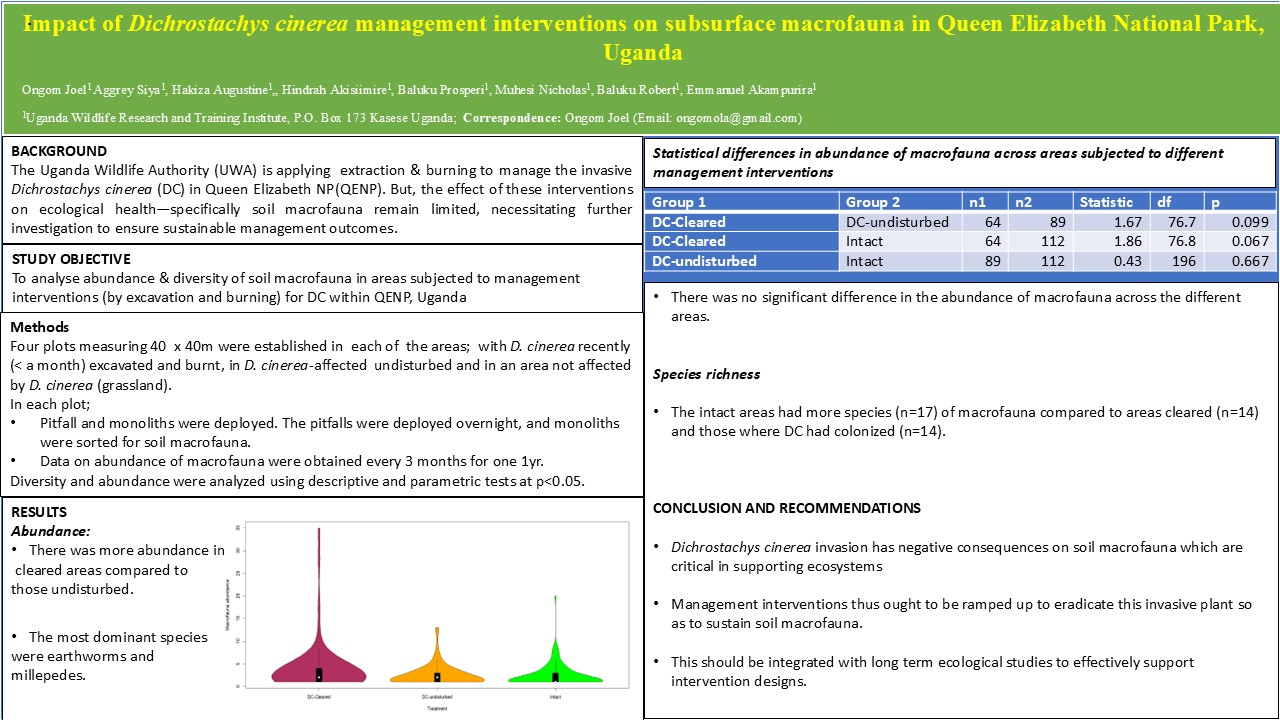
Invasive woody encroachment by Dichrostachys cinerea has transformed large areas of savanna within Queen Elizabeth National Park (QENP), yet the ecological consequences of its community-based management—primarily uprooting for charcoal or firewood and burning of smaller branches and non-usable biomass—remain insufficiently understood. This study evaluates the effects of this ongoing manual intervention on soil physicochemical properties and the abundance and diversity of above- and below-ground macrofauna.
Study Design
The study employs a replicated plot-based design to compare ecological conditions across three distinct management zones within Queen Elizabeth National Park.
Management Zones
🌾 Recently Cleared Sites
Areas where D. cinerea has been manually removed through uprooting and burning
🌳 Undisturbed Thickets
Dense D. cinerea thickets with no management intervention
🌿 Non-invaded Grasslands
Control sites representing natural savanna conditions
Plot Design
4 plots per site, each measuring 40 × 40 meters, used to collect soil samples and macrofauna data
Data Collection Methods
Soil Sampling
Soil samples collected at three depths: 0-10cm, 10-20cm, and 20-30cm
Macrofauna Collection
Methods based on the Tropical Soil Biology and Fertility (TSBF) protocol:
Preliminary Analysis Results
Key Statistical Findings
Soil Properties Analysis
PERMANOVA revealed significant multivariate differences in soil properties across Site × Depth combinations (F = 2.21, R² = 0.43, p = 0.001), while PCA indicated clear separation of soil fertility profiles along the invasion gradient.
Cleared Areas
Exhibited elevated exchangeable cations (K, Na, Mg), available P, and higher bulk density, reflecting short-term nutrient enrichment following the intervention.
Grassland Soils
Showed higher organic carbon and calcium content compared to other zones.
Undisturbed Thickets
Were nutrient-depleted, indicating the negative impact of D. cinerea invasion on soil fertility.
Macrofauna Diversity Results
Below-ground Richness
Grasslands supported the highest below-ground species richness (n = 17) and overall diversity
Undisturbed Thickets
Exhibited the lowest diversity across indices for below-ground macrofauna
Above-ground Richness
Was highest in thicketed areas but did not translate into higher overall diversity
Study Conclusions
Main Findings
Collectively, the findings indicate that Dichrostachys cinerea invasion suppresses soil fertility and below-ground biodiversity, and that manual uprooting combined with targeted burning partially restores edaphic conditions and supports macrofaunal recovery.
These results underscore the ecological value of low-impact, community-supported removal strategies for enhancing soil health and biodiversity in invaded African savannas.
Conservation Implications
- Community-based manual removal is an effective restoration strategy
- Short-term nutrient enrichment occurs post-intervention
- Below-ground biodiversity recovers with management
- Low-impact methods preserve soil ecological functions
- Approach is scalable for other invaded African savannas
Access Full Research Report
Download the complete study findings, GIS maps, and detailed recommendations
Download Research Report (PDF)