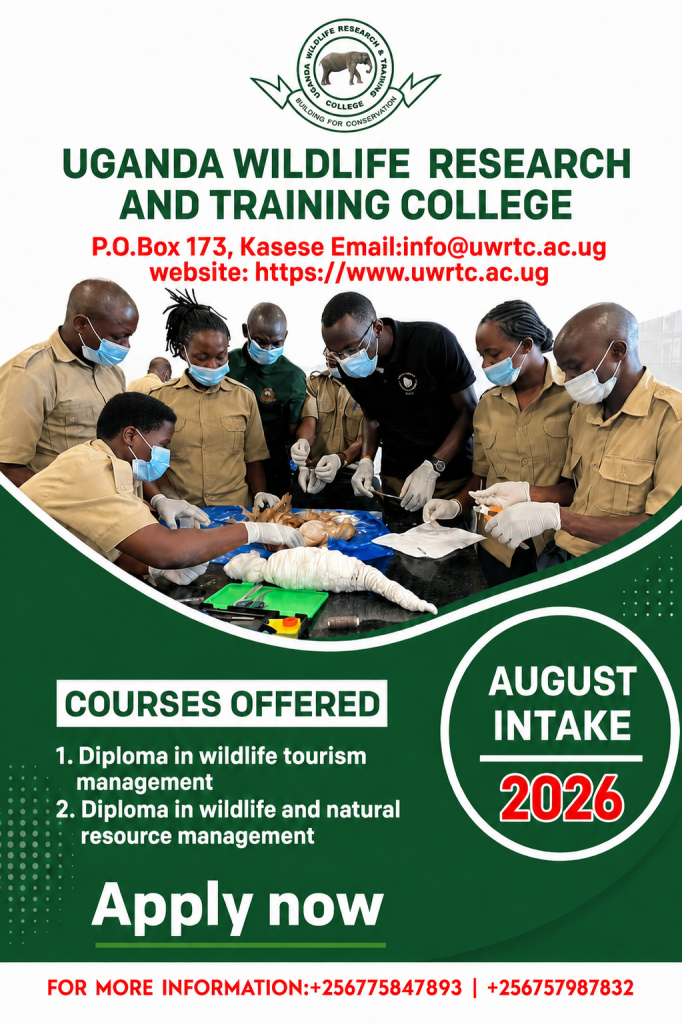
Diploma in Wildlife & Natural Resource Management (DWM)
Uganda’s exceptional ecosystems and wildlife diversity require a skilled technical workforce to manage populations and conservation areas according to sound conservation principles. This diploma develops middle-level managers who can support sustainable development and effective protected area stewardship.
Programme Goals
To build technical capacity of middle-level managers in wildlife and natural resource management.
- Comprehend and relate concepts and principles governing wildlife resource conservation.
- Initiate and manage wildlife-based enterprises effectively.
- Provide animal welfare and observe occupational health & safety.
- Provide wildlife-related advisory services.
- Participate in implementing policies and legal frameworks in wildlife and natural resource management.
- Safely handle and use relevant field tools and equipment for managing wildlife.
- Apply analytical skills in research, planning, and decision-making.
- Respond confidently to emerging issues in wildlife resource conservation.
- Communicate and advocate for wildlife resource conservation.
- Explain basic principles in environmental and social impact assessment.
- Demonstrate appropriate leadership skills.
- Equip learners with concepts and principles governing wildlife resource conservation.
- Impart knowledge and skills to manage wildlife-based enterprises effectively.
- Instill skills to provide animal welfare and observe occupational health & safety.
- Build skills in planning, delivery, and monitoring of wildlife-related advisory services.
- Empower learners to implement policies and legal frameworks in wildlife and natural resource management.
- Equip learners with skills to handle ballistics and use relevant field tools and equipment for managing wildlife.
- Instill analytical and reporting skills for research, planning, and decision-making.
- Develop abilities to respond to emerging issues in wildlife resource conservation.
- Build communication and advocacy skills for wildlife resource conservation.
- Introduce principles in environmental and social impact assessment.
- Develop appropriate managerial skills in wildlife resource conservation.
Entry Requirements
- At least one principal pass and two subsidiary passes obtained at the same sitting at A’ Level in science subjects including Biology.
- OR at least a credit certificate in wildlife and natural resource management (or equivalent) from a recognized institution.
Resources & Field Training Environment
Training is supported by partnerships and a uniquely placed learning environment that prioritizes hands-on exposure and applied practice.
Apply for Admission
Join UWRTC to gain practical competencies for managing wildlife and natural resources in protected areas, community landscapes, and conservation-linked enterprise settings.